Success Stories

How ProMoss™ Transformed a Fouled Cooling Tower: Eliminating Scale While Reducing Water Usage by 40%

Sustainable Programs, Efficiency & Cost Savings

Commercial & Institutional

How ProMoss™ Transformed a Fouled Cooling Tower: Eliminating Scale While Reducing Water Usage by 40%

Executive Summary

This case study demonstrates the effectiveness of ProMoss™ green sustainable treatment in addressing severe fouling and scaling issues in cooling tower systems. The study compares ProMoss™ performance on both a heavily fouled existing tower and a clean newly installed tower, providing insights into optimal implementation strategies.

Problem: A commercial building's cooling tower was severely fouled and scaled due to conventional chemical treatment, causing high water usage and poor efficiency.

Solution: Implemented ProMoss™ green sustainable treatment program.

Key Results:

  • Eliminated existing fouling and scaling issues
  • Increased cycles of concentration (reduced water usage)
  • Improved microbiological control (99%+ compliance)
  • Clean towers showed immediate results; fouled towers improved over time
  • Environmentally sustainable solution

Bottom Line: ProMoss™ successfully transformed a problematic cooling tower system into an efficient, sustainable operation with measurable water savings and superior performance.

Background and Challenge

A commercial building in the southeastern United States was experiencing significant operational challenges with their cooling tower system. The facility had been using a competitor's conventional chemical treatment program, which resulted in severe scaling conditions, fouled cooling tower fill, reduced system efficiency, and high water consumption due to limited cycles of concentration.

The building management team recognized the need for a more sustainable approach that could simultaneously clean the existing fouled system, increase cycles of concentration, minimize water usage, and control microbial activity.

Solution Implementation

CRB Water, working in partnership with their Authorized Dealer, implemented ProMoss™ as a comprehensive green sustainable cooling tower treatment program. ProMoss™ was specifically selected for its ability to:

  • Address existing fouling and scaling issues
  • Improve water efficiency through increased cycles of concentration
  • Eliminate scaling potential and biological growth
  • Provide environmentally sustainable treatment

Implementation Process

The implementation involved comprehensive wet chemistry testing throughout the application phase. All test results were systematically recorded and shared with the customer to ensure transparency and demonstrate measurable results.

Results and Analysis

Chemical Performance

Upon application, ProMoss™ demonstrated immediate positive system response by effectively cleaning existing deposits. The treatment works through a unique chemical mechanism where ProMoss™ facilitates the exchange of positively charged ions, resulting in the release of hydrogen ions. This process:

  1. Neutralizes calcium scaling potential
  2. Reduces cooling water alkalinity
  3. Lowers the Langelier Saturation Index (LSI)
  4. Mitigates future scaling risk

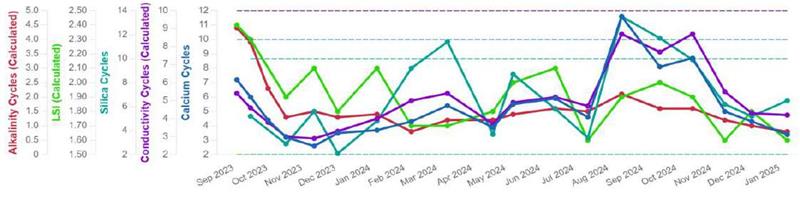
Figure 1: Cooling Tower Cycles

image

Figure 1 illustrates ProMoss™'s ability to increase cycles through conductivity while maintaining steady alkalinity levels. This mechanism reduces scaling potential while simultaneously removing existing deposits. 

 Component

Test

Avg

Days

 Tests

 High

 Low

 % in Range 

 Cooling Tower

Calcium Cycles

5.33 

520 

19

1

0

 94.74%

 Cooling Tower 

Conductivity Cycles (Calculated)  5.0  520

19

0

0

 100%

 Cooling Tower 

Silica Cycles

6.81 

520

17

3

0

 82.35%

 Cooling Tower 

LSI (Calculated) 

1.91 

520

18

0

0

 100%

 Cooling Tower 

Alkalinity Cycles (Calculated) 

1.69  520

19

0

0

 100%

Comparative Analysis: Fouled vs. Clean Tower

A significant finding emerged from comparing ProMoss™ performance on the fouled tower versus a newly installed clean tower. The clean tower showed immediate and dramatic results, while the fouled tower required additional time to achieve optimal performance. This difference was attributed to ProMoss™ working progressively to eliminate existing scale deposits on the fouled tower, which initially limited alkalinity reduction and cycle improvements.

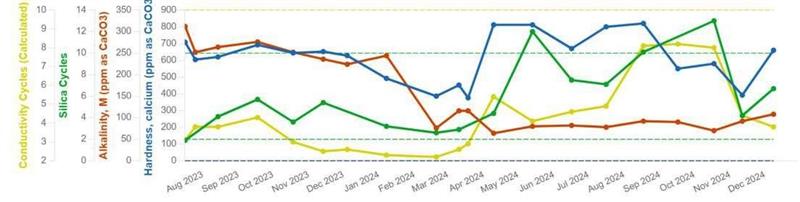
Figure 2: New Tower Start Up

new-tower-start-up


Figure 2 demonstrates the impact of implementing ProMoss™ treatment on the new clean cooling tower beginning in March 2024.

The results show:

  1. Immediate increase in conductivity and cycles
  2. Significant reduction in alkalinity
  3. Maintenance of healthy LSI levels
  4. Enhanced ProMoss™ effectiveness without existing scale interference


 Component

Test

Avg

Days

 Tests

 High

 Low

 % in Range 

 Cooling Tower

 Hardness, calcium (ppm as CaCO3) 

 617.5 

 533 

20

0

0

 100% 

 Cooling Tower 

 Alkalinity, M (ppm as CaCO3)    156.2    533 

20

0

0

 100%

 Cooling Tower 

 Silica Cycles 

 5.9 

 533 

16

3

1

 75%

 Cooling Tower 

 Conductivity Cycles (Calculated) 

 4.23 

 533 

20

0

0

 100%


This comparison illustrates how starting with a clean system allows ProMoss™ to work optimally with existing tower water chemistry while maximizing cycles of concentration and minimizing blowdown to sewer.

Microbiological Control

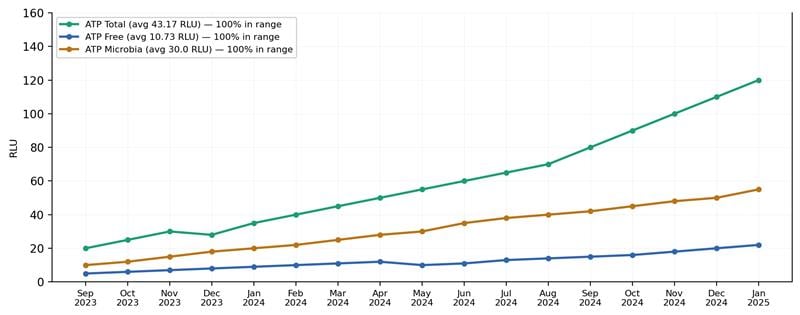
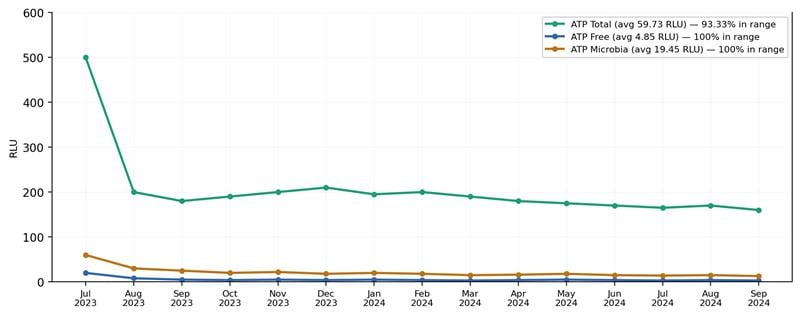
In addition to superior scaling control, ProMoss™ demonstrated excellent microbiological performance. Both test towers maintained microbiological growth within acceptable ranges nearly 100% of the trial duration, as measured through ATP sampling and testing.

Figures 3 and 4 show the overall reduction in microbial (RLU) and Total ATP bio counts, demonstrating measurable improvements in microbiological control. The data reveals a direct correlation between scale removal and microbiological reductions.

Figure 3: Microbiological — Fouled Tower

microbiological-fouled-tower


 Component

Test

Avg

Days

 Tests

 High

 Low

 % in Range 

 Cooling Tower

 ATP Total (RLU) 

43.17  

520

18

0

0

100% 

 Cooling Tower 

 ATP Free (RLU)    10.73    520 

15

0

0

100%

 Cooling Tower 

 ATP Microbia (RLU)

30.0

 520 

15

0

0

100% 

Figure 4: Microbiological — Clean Tower

microbiological-clean-tower


 Component

Test

Avg

Days

 Tests

 High

 Low

 % in Range 

 Cooling Tower

 ATP Total (RLU) 

59.73

465

15

1

0

93.33% 

 Cooling Tower 

 ATP Free (RLU)    4.85 465 13

0

0

100%

 Cooling Tower 

 ATP Microbia (RLU)

19.45

 465

11

0

0

 100% 

Optimization Strategy

Based on these findings, CRB Water's dealers recommend a light acid wash prior to ProMoss™ application for moderately scaled systems. This pre-treatment ensures maximum water savings and optimal system performance from the start.

For optimal results, CRB Water recommends:

  1. Comprehensive system assessment prior to implementation
  2. Light acid wash for moderately to heavily fouled systems
  3. Continuous monitoring through wet chemistry testing
  4. Regular ATP sampling for microbiological verification

Conclusions and Recommendations

The successful implementation of ProMoss™ presents a compelling case for adopting green sustainable treatment solutions in cooling tower applications. Key benefits demonstrated include:

  • Effective resolution of existing fouling and scaling issues
  • Enhanced cycles of concentration leading to significant water savings
  • Measurable performance improvements through comprehensive testing
  • Environmentally sustainable treatment approach
  • Superior microbiological control

This case study establishes ProMoss™ as a transformative solution and provides valuable insights for developing future treatment strategies tailored to specific cooling system conditions.

ProMoss™ Delivery Options

CRB Water has contact chambers for every application and system setup. Open cage submersible chambers are used when there is an open body of water to be treated. The offline contact chambers are uniquely designed to create a tumbling action that creates a maximal moss and water interface.